

Six weeks.
That's how long a leadership team I coached spent deciding between Slack and Teams.
The CEO was scared they weren’t going to make the right choice. That if they ended up having to “switch back and forth,” the staff would get confused and frustrated with them.
It’s just a messaging app, bro.
You can switch back and forth. That’s allowed.
But most of the leadership team couldn’t see that. Because in their minds, this wasn’t a small decision about communication tools. It was an important and permanent commitment that they thought would define the company’s culture, communication and overall success.
They were treating the decision like they were contemplating marriage.
(I’m guessing it’s pretty obvious why they needed some senior leadership team coaching)
The Big Problem With Decision-Making
You’d be surprised to learn how many leaders struggle with decision-making.
Or maybe you wouldn’t be surprised.
But I’m surprised, and that has to count for something.
What I’ve noticed in my executive coaching work, is that most leaders aren’t actually bad at making decisions.
Most leaders are bad at knowing what type of decision they’re making.
That’s an important distinction.
I’m sure you’re good with the obvious, black-and-white decisions. But most leadership decisions aren’t simple like that.
Most leadership decisions live in the grey area - where you may not know the impact until after you make the decision.
The problem is that your probably tend to treat most of those decisions as if they’re irreversible. Like one wrong move is going to destroy your entire legacy.
You treat decisions like there’s no backsies.
Maybe you spiral into analysis paralysis. You need more data, more time, more meetings that discuss the same thing the last meeting discussed.
There’s a solution to all this. And I’m going to tell you what it is.
But first we need to talk about dating.

Your Relationship Status In Decision-Making
I don’t know your relationship status (mostly because the era of “your relationship isn’t official until it’s on Facebook” ended ten years ago).
But unless you’re in an arranged marriage, you know the game:
You go out on a bunch of dates
A few of them turn into more committed relationships
In the rare case, it may lead to marriage
As it turns out, this is exactly how decision making works. There are three levels of commitment in both relationships and decision-making. Here they are:
→ First there are Dating Decisions
These are low-risk choices. Sometimes they’re fun to do, sometimes not so much. Either way, you try something, and if it doesn’t work, you stop.
There’s minimal pain. Minimal fallout. Maybe a little embarrassment, but hey, at least you learned something, right?
→ The next are “Seeing Someone” Decisions
These are more of a commitment and they require a little bit more of an investment.
Sure, with “Seeing Someone” decisions you can change course if you need to, but there’s bound to be some discomfort in doing that. There always is.
Something is going to be lost, but it’s not the end of the world.
That said, once you commit to a Seeing Someone decision, it’s probably best to stop thinking about other potential choices. Even the really hot one that just walked past you on the sidewalk and gave you that look.
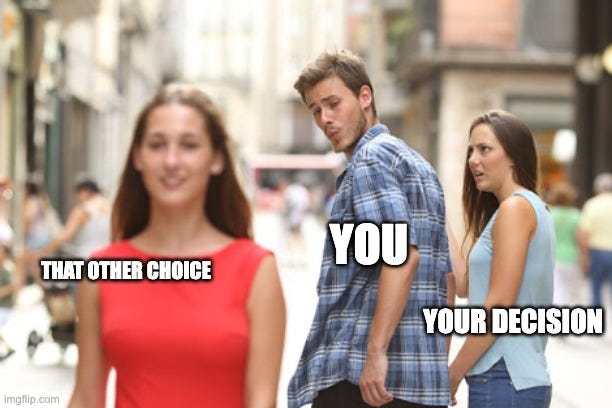
→ The last type are Marriage Decisions
These are life-changers. They’re really hard to reverse. Once you commit, you’re in it.
Changing your mind could mean arguments, lawyers, spreadsheets, and a meaningful change to your company’s trajectory.
People have strong opinions about marriage decision’s. They choose sides. Sometimes you’re forced to lose that relationship with your bestie because of it.
Here’s the problem: Most leaders treat dating-level decisions as if they’re being forced to walk down the aisle.
⸻

The Leadership Problem: Everything Feels Like a Marriage
A lot of people treat every grey-area decision like it’s irreversible.
As a leadership team coach, I’ve seen teams freeze over all sorts of topics, like:
Testing a new product idea
Selecting project management tools
Figuring out a new PTO policy
This is why innovation stalls.
It’s why cultures begin to corrode.
Because leaders assume every decision is a permanent commitment.
But just like in real life…
Most decisions are dating level.
Some are “seeing.”
Almost none are about marriage.
Knowing which type of decision you’re making is the difference between productivity and stagnation.
When you treat everything like a marriage, you create an environment where everything feels like its high-stakes.
Your team learns that changing course could mean failure. They learn that being wrong can be dangerous.
So everybody gets scared to make decisions - even small ones. They overanalyze and they always “wait for more data,” because the environment states that one wrong move could ruin their professional prospects.
To be clear, you’re the one that created that culture. It’s your fault. And if you’re not the leader, it’s theirs.
It’s the pattern of treating everything like a marriage that creates the environment of cautiousness and fear.
But there’s a way out of this. I told you there was going to be.
And it’s a pretty easy way.
Because once you see it, you’re not going to be able to unsee it again.

How to Become a Better Decision-Maker
There’s a simple decision-making framework I teach my coaching clients that helps you become a more effective decision-maker and create a more agile and creative culture. Here it is.:
Be clear on the type of decision that needs to be made: Dating, Seeing or Marriage. This isn’t about your emotions or fears.
If you think it’s a Marriage decision, try to break it down into a smaller series of dating or seeing decisions. In almost every case, that can be done.
Match your decision-making process to the level of the actual decision. Here are the processes for each:
Dating Decisions → Decide fast, test it and learn from it. You don’t need all the info to make the decision, just enough to move forward and see what happens.
Seeing Someone Decisions → Commit with an exit plan. Involve a few other stakeholders. Think of how to make it a long-term, committed solution, but plan for a way out and, most importantly, when you’re going to make the call, and what specific milestones will determine the decision.
Marriage Decisions → Slow down, but don’t roll to a stop. Think deeply about your choice and its long term impact. Make sure you have the information you can reasonably get, then make the decision. Don’t freeze at the alter just because you’re nervous. Nervousness is natural.
Communicate the level of decision-making to your team. In fact, teach your them this process. Feel free to forward this to them. I’ll put a share link below for you. It will transform your environment.
The Big Close
Decision-making isn’t about being right. It’s about learning fast. And you can’t learn fast if you’re too afraid to try.
Most leaders don’t suffer from bad decisions. They suffer from not understanding its level of seriousness.
So here’s my advice: Date more. Experiment. Learn. Have a little fun. After all, you’re young and have a full life of commitments ahead of you.
Sure you’re going to make some bad choices, we all do. (It was just a phase in college). But you’re also going to make good ones. In both cases, there’s a lot of learning that happens.
Remember, if everything feels like it’s high stakes, nothing actually is.
So decide more. Stress less.
And stop treating every decision like it’s a marriage proposal.
PS — The Slack vs. Teams team, by the way? They picked Teams. Six weeks later, 70% of the company was using Slack anyway. Turns out they survived. Your team will too.
I put on free Leadership Diagnostic Workshops that help you identify all the patterns holding you back, and how to overcome them.
Secure your spot in a Diagnostic Workshop now
Related Articles
350. AI Isn't The Problem. Your Decisions Are.

This is The Best Leadership Newsletter Ever. Become the leader people want to follow - in 5 laugh-out-loud minutes a week

=
Hey, even marriage is a reversible decision... I've been there twice. LOL.
I appreciate how this strategy adds nuance to the Type 1 (irreversible) vs Type 2 (reversible) decision framework, specifically by splitting reversible into low- or high-impact.