
This is The Best Leadership Newsletter Ever. Become the leader people want to follow - in 5 laugh-out-loud minutes a week
When it comes to creating a high-performing team, there’s one trait that matters more than any other.
It’s not individual talent.
It’s not accountability.
It’s also not structure or hierarchy or even the team members being friends.
The single most important element to successfully creating a high-performing team is…
Psychological safety.
<cue screeching tires>
<cue collective gasp>
I know. I was surprised too.
Psychological safety sounds squishy. It feels like it’s leftover woo-woo wording from the woke times.
It definitely doesn’t feel like the main thing that should separate great teams from mediocre ones.
So what gives?
Turns out, it all started with Aristotle.
Project Aristotle And High-Performing Teams
In 2012, Google launched Project Aristotle, a multi-year research initiative to answer a seemingly simple question:
What makes a team effective?
They studied hundreds of teams and, in the process, they analyzed everything leaders obsess over, including:
Seniority
Team structure
Management style
IQ, EQ and all the other Qs
Basically, they looked at all the things.
And what they expected to matter most, completely didn’t.
The number one predictor of successful teams is whether or not people feel safe speaking up.
Teams perform better when people feel safe to make mistakes, challenge ideas, and disagree without fear.
That’s psychological safety.
Take a second to think of the best teams you’ve been part of - not just work-related, it could be sports teams, family gatherings, AA meetings, whatever. Isn’t it true that the team you found the most gratification is the one that had the most psychological safety?
So why the heck isn’t every leader focusing on creating psychological safety?
That’s a damn good question.
You know, you really are smarter than they say.

Why Leaders Resist The Idea of Psychological Safety
Leaders don’t ignore psychological safety because they think it doesn’t matter. They ignore it because it makes them feel less in control.
When it comes right down to it, control is about ego. (I can explain that in a different article if you think I’m wrong.)
You can’t have psychological safety and a leader with a big ego. They’re mutually exclusive properties.
Psychological safety can’t be controlled like your underlying need to control your employees. It can’t be measured or monitored on a dashboard. And it definitely can’t be fixed with a reorg or by instilling new processes.
Psychological safety is created or destroyed by the leaders behavior.
Period. Full stop.
If you’re the leader, you are fully responsible for psychological safety. And let me tell you, it can be really fucking uncomfortable to create it.
It requires you to recognize and accept that your team’s performance problems aren’t just about them.
The problems are about you.
Let me give you a real world example.
The High Performing Team That Wasn’t
I work with a mid-sized tech company (~$30m in revenue when they first hired me). Their leadership team seemed flawless on paper.
They were clearly smart people with impressive resumes that included a bunch of ivy-covered halls. The company’s revenue had been growing at a steady pace and the team even had weekly leadership meetings to stay on top of their growth.
If you were looking at them from the outside, everything looked great.
From the inside? Not so much.
I was called in because, as I was told, they needed “to be better aligned.”
As it turns out, sales were slowing and progress was puttering along at a pretty poor pace. In other words, things felt broken and they didn’t know why.
I asked to sit in on their next leadership meeting and here’s what I noticed:
Everyone agreed with each other. And they did it quickly.
A little too quickly.
I noticed that no hard conversations happened in that meeting. In fact, they were pushed aside the moment tension started appearing, so no discussion or decisions about them were made. The only decisions they made seemed like pretty darn safe ones.
Either they all didn’t care enough to disagree or they were too scared to do so.
At the end of the meeting, I asked one question to the group:
What is one thing that everyone here sees happening, but no one feels safe to talk about?
You know what their answer was?
They didn’t say one.
It’s not that they didn’t have an answer. It’s that they didn’t say it.
I could tell by the downturned eyes and the butts shifting in seats that people had something to say. It’s just that no one felt secure enough to speak up.
I sat in the silence for awhile to see what would happen.
Finally, the CEO called the meeting over, and that told me everything I needed to know.
The team knew they had problems, but they didn’t feel safe talking about them with the CEO around. So they stayed quiet.
And the CEO assumed that their silence meant alignment.
He assumed that all was good because nobody spoke up.
It wasn’t.
It only took me one question to confirm that their problem was a lack of psychological safety.

Silence Is Not Agreement
When no one pushes back on your ideas…
When meetings don’t address the tension…
When most decisions seem to be unanimous…
Some leaders call that alignment.
But they’re wrong.
When there is no pushback, there is usually no psychological safety.
Here’s what will inevitably happen with your team without that safety:
More problems will start popping up
People will start hiding their mistakes from others
Innovation and creativity will die a sad, lonely death
Growth will slow down and productivity will peter out
When this happens, leadership usually doesn’t understand why.
How do I know this? Because I did the same exact thing with my first companies. I was too scared to lose control so I held on tightly. By doing that, I choked psychological safety until it had no air to breathe.
I learned the hard way.
Don’t be like me.
How Leaders Accidentally Kill Psychological Safety
You don’t destroy psychological safety with your policies. You destroy it with your behavior. Let me ask you a few questions.
Do you get defensive when somebody gives constructive feedback?
Do you react emotionally to bad news?
Do you shut people down when they give you new ideas?
Do you berate people - overtly or subtly - for making a mistake?
If you do even one of those things, you are destroying psychological safety.
Maybe you don’t know you’re destroying psychological safety, or maybe you’re justifying your behavior in some way that makes sense in your brain. It kinda doesn’t matter, the result is the same.
What Psychological Safety Is Not
Let me be crystal clear on this so we don’t get confused.
I had this talk with one of my executive coaching clients recently, and she said it sounds like I’m telling her to just be nice to everybody, lower her standards and avoid conflict.
That is NOT what I’m saying.
To the contrary, maintaining high standards is really important for maintaining psychological safety. After all you can’t have a high-performing team without high standards.
The safest teams are the ones that argue and debate and disagree - and they can do it all without fear of retaliation or being berated.
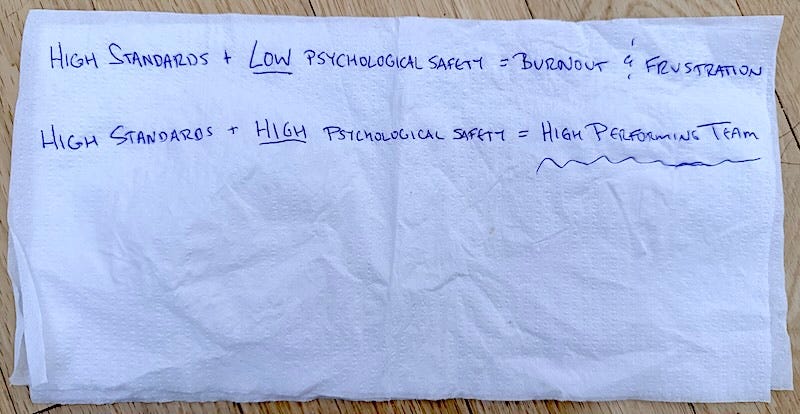
I see this dynamic of high standards and psychological safety play out everywhere. If you pay attention to team dynamics, you’re going to see it too.
Now let’s get back to my client with the team alignment problem. That $30m company (who, by the way, are a $55m company now)
When Leadership Learns How To Create A High Performing Team
Once I helped the CEO recognize how his behavior was shutting people down, everything changed. In fact, it changed pretty quickly.
He learned to pause instead of becoming emotional.
He learned to be curious and questioning instead of correcting people.
And he heard hard feedback and kept his mouth shut instead of showing his defensiveness.
Soon enough, the entire culture of the company improved. Meetings became more meaningful and that led to faster decisions.
Oddly enough, productivity started improving and growth kicked in again.
Go figure.

Why This Matters More Than Ever
As I’m sure you know, we are in a world where change is happening faster than ever before. The future feels uncertain and AI-driven disruption is causing a whole lot of anxiety.
Psychological safety is no longer optional. It is required for survival.
The teams that feel safe are the ones that will learn faster, adapt more quickly and outperform their competition consistently.
Psychological safety is the new edge for business success. You need it now.
So as technology takes over our lives, it’s time to make it safe to be human.
If this feels familiar, I run guided workshops where leaders make sense of why leadership feels harder — and how they can make it easier.
[Editor’s Note: you won’t win a ferrari. there is no ferrari giveaway. please share the article anyway]