
Let’s face it - the LinkedIn messaging system is broken. If you’re like me, juggling multiple conversations on LinkedIn (especially after this post went uber-viral), you need something better. Much better.
I stumbled on Kondo and I’m in love.
LinkedIn really needs to buy this company and use it for it’s DM-ing.
They aren’t paying me to say this. I’m just telling you.
If you’re frustrated with LinkedIn DM, get a free month of Kondo on me.

Some of the largest companies in the world pay me to be a part of their brainstorms.
Kraft brought me into a room with their executives to figure out their next sandwich idea.
eBay had me help shape their youth marketing strategy.
Nestle had me help with ideas on how to make some of their candy more relevant.
I’ve done similar things with Sony, Citi, Nike, USA Today, Universal. And the list goes on.
I’m telling you, I kill it in a brainstorm.
Executives have referred to me as one of the most creative people they know.
But here’s my secret:
I’m not.
I’m rarely the smartest person in the room.
I’m often the least creative.
And I’m almost always the one who knows the least about the product.
So why do they keep inviting me back?
Because I'm not in the room to come up with ideas.
I'm in the room to fix the room.
Why Brainstorms Don’t Work
The multi-billion dollar ad agency BBDO was born when four guys got together. Three had last names that started with B, B and D. The fourth was Alex Osborn.
But Osborn’s most popular achievement isn’t as co-founder of BBDO. Because was the person who invented the brainstorm.
His premise seems obvious now: Put a group of people in a room, ban criticism, and they’ll come up with better ideas - and more of them - than if they tried to do it alone.
Everyone loved it.
It seemed to work.
He even wrote a book about it
Now here we are, 80 years later, and the brainstorm is still going strong.
There’s only one minor problem.
Research continues to prove that group brainstorming doesn’t work.
It produces fewer ideas, and lower-quality ones, than if the same people worked alone and then pooled their results.123
So what the heck is going wrong with the brainstorm?
As it turns out, there are a few things. And it starts with something called Production Blocking.
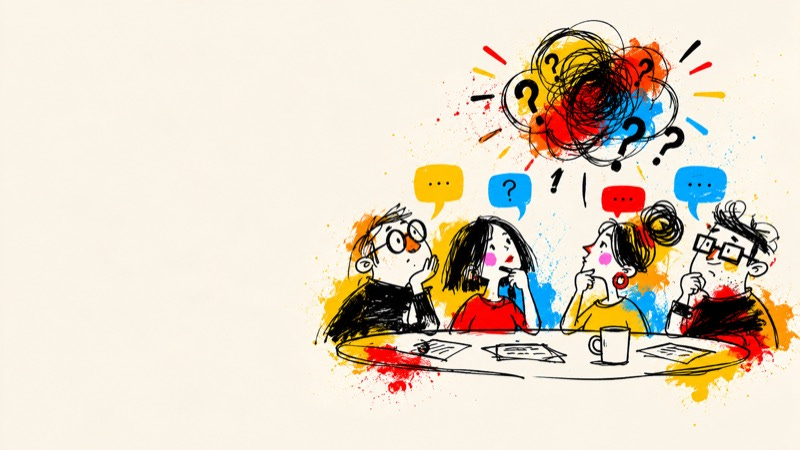
What The Hell Is Production Blocking?
The nice thing about brainstorming in a group of respectful people is that when somebody talks, everybody else listens, and waits their turn to speak.
As it turns out, that’s not just nice - it’s also not helpful.
Because as you’re listening to others speak, your idea just sits there. Maybe you forget what it is before you even say it. Or the conversation moves on and it just doesn’t feel right to share anymore.
This is called production blocking, and it’s why some of the best ideas in most brainstorms never get shared.
But that’s not the only problem.
There’s also a problem with hierarchy.
In the 1970s, sociologists found that the people in the room with the most status do the most talking. Fifty years later, it still happens. They’re still talking.
But it’s not just about the amount of time they speak. It’s about their ideas.
Because of their status, their ideas get weighted more heavily than other people’s ideas. It doesn’t even matter whether or not they’re better.
Pay attention to these two things in your next brainstorm. You’ll see both of them happen.
The good news is that there’s a way around it.
And that’s my secret.
How To Fix The Room
As I said earlier, I’m not invited into the room to be the person with the best ideas.
I’m in the room to fix the room.
The ideas aren’t broken. The room is.
And there are two things I do that make the difference between an amazing strategy session and a grand waste of time.

Antidote #1: Ask the right questions to get the best ideas
Most brainstorming sessions start with someone asking, “What ideas do you have?”
And then there’s that awkward silence until everyone starts talking.
Well, not everyone.
Usually a few people start (we all know who they are), while everybody else listens, waits their turn and tries to remember that brilliant thought they had three minutes ago.
But that’s the wrong way to start, and the wrong question to do it with.
I do something different.
I get people thinking about the same problem before anyone starts sharing their answers. And it starts with better questions than “what ideas do you have?”
The goal is to get people to think differently right out of the gate. I do that by challenging them with questions like:
If we could do anything, what could we do that would scare the shit out of our competitors?
or
What would have to be true for us to completely own this market?
Then I give everyone a few minutes to quietly think, and write down their answers.
Individually.
No talking. No interruptions. No waiting for the loudest person to finish their brilliant monologue.
Everyone gets to develop their own ideas before the group starts influencing them.
Because the best way to get more ideas out of a room is to stop making everyone compete for the opportunity to share them.
And once everyone has their ideas down, that’s when the real discussion begins.

Antidote #2: Find the ideas that are hiding scared
Here’s something I’ve learned after sitting in hundreds of these meetings.
The person doing the most talking is rarely the person I’m most interested in hearing.
I’m looking at the people who aren’t talking.
Especially the ones who’s eyes look like they have something to say.
I led a strategic brainstorming session a few months ago with the leadership team of a $300 million company.
We were having a pretty good discussion about growth strategies.
But while everyone was talking, I noticed something.
The CTO was silent.
We weren’t discussing technology, so nobody really expected him to contribute much. But I kept watching him.
His eyes were doing a hell of a lot more talking than his mouth.
So I stopped the conversation and asked his opinion.
He said six words.
“Why don’t we just acquire [partner company]?”
The room went silent.
Not because it was a bad idea.
Because nobody else had even considered it.
And the more we talked about it, the more obvious it became that this was a great idea - and something worth exploring.
Six months later, they finalized the acquisition. They now expect it to increase revenue by 40%.
All because of six words that almost never got spoken.
And here’s the part that nags at me.
That idea was already in the room ready to be said.
It didn’t need to be invented. It just needed to be heard.
That’s what happens in brainstorms. It convinces some people their ideas are more important and makes others believe that their ideas aren’t worth sharing.
Most people don’t even realize it’s happening. Which is why I spend so much time watching the people who aren’t talking.
Most of the best ideas I’ve “had” in brainstorms weren’t mine at all. I just find the corner they’re cowering behind and encourage them out.
Some days it feels like the greatest con I’ve ever pulled.
It isn’t.
It’s the whole job.

The Single Worst Way To Kill A Room
Now, you might be thinking you don't have the luxury of hiring a business consultant like me to facilitate every meeting. Fair enough.
But there's one thing you can do yourself that’ll make an enormous difference. And it's probably the opposite of what you normally do.
Think of the brainstorming meetings you’ve been a part of. I’m sure this one exists:
The energy is good. The ideas are flowing.
Somebody says something really interesting and, before it’s discussed further, the most senior person in the room opens their mouth and says, “What if we...”
And everything changes.
The energy of the room shifts and everybody knows it but the leader.
Heads nod.
Mouths close.
Every new idea is suddenly a version of the boss’s.
Nobody decided to change the dynamic. It’s just what happens when hierarchy gets in the way.
If you’re a leader, you probably think your job in a brainstorm is to come up with the best idea.
You’re wrong.
The moment you share your ideas, it becomes a magnet. Suddenly the entire room is brainstorming ways to make your idea work
In a brainstorm, being the smartest person in the room isn’t an asset. It’s the most dangerous person in the room.
What To Do Instead
So here’s what I want you to try in your next brainstorm.
Don’t ask, “What ideas do you have?” Ask a question that makes the whole room think deeper.
Watch the people who aren’t talking. Especially the ones whose eyes are.
And if you’re the most senior person in the room, talk last. Or get the hell out of the room.
Six words from a quiet CTO changed an entire company. Now think about how many six-word ideas have died in your meetings because someone more important spoke first.
The best brainstormers aren’t the ones with the best ideas.
They’re the ones who make sure the best idea gets said.
So don’t try to fix the brainstorm.
Fix the room.
P.S. The CTO who said those six words? He almost didn’t say them. The first time I asked, he said “it’s nothing.” I actually had to ask him twice. Think about that the next time you skip around the table.
This is a fantastic piece. I’m guessing that you don’t sleep😎 There’s a lot of information here that I was clueless about. Thanks Jeff and keep burning the midnight oil.