
I have one direction for you before you read this article:
Whatever you do, don’t think about the pink elephant standing behind you.
Ok. Now let’s talk about dieting.
At any given time, about half of the people in the United States are trying to lose weight. Odds are, you’re probably doing some combination of a new diet, more exercise or maybe even some magical medication.
You may have lost some weight in the process.
If you’re committed enough, you will lose some weight in the process.
Which means you’re going to be really disappointed by the next thing I tell you.
It’s probably not going to work.
Within 4-5 years of losing weight, as many as two-thirds of dieters regain more weight than they lost.1
In other words, trying to lose weight makes you gain weight.
This is a problem.
But it’s not just a dieting problem.
It’s also a problem with how you act at work.
The Pink Elephant You Aren’t Thinking About
You know what? Let’s talk about that pink elephant. The one you’re trying not to think about.
There’s this guy, Daniel Wegner, who was a professor at Harvard and did a bunch of other smarty-pants stuff. He and his colleagues decided to study how people suppress their thoughts.
The study started off by telling people not to think about a white bear.
What he discovered is that when you consciously try not to think about a white bear, you keep thinking about a white bear.
Wegner called this the Ironic Process Theory. He also called it the Rebound Effect. And the White Bear Experiment. Clearly the fella had a bit of trouble with decision-making.
Anyway, the basic gist of Wegner’s finding is that the harder you suppress something, the harder it returns. People trying to quit smoking by not thinking about smoking end up thinking about smoking more than when they were smoking.
This is why dieting fails and why a pink elephant won’t leave your brain when I tell you not to think about a pink elephant standing behind you.
Suppression doesn’t work - not for thoughts, not for weight, and not for behavior.
And this brings us right back to you.
Why It Works For Two Weeks And Then Stops
There is undoubtedly some habit you have at work that you wish you could change.
Maybe you want to stop avoiding conflict.
Or you want to delegate more.
Maybe you need to be more patient with other people when things aren’t exactly going your way.
So you decide to change.
You decide to just delegate more. Or whatever your thing is.
And it works.
It works the entire week. Maybe it even works the next week. You’re excited. You feel proud. You’ve cracked the damn code.
Yay you.
But then, inevitably, stress hits.
Maybe it’s a pending deadline or a raging fire you have to put out. And suddenly the old behavior comes back. Usually without you even noticing.
But this time it comes back stronger.
That’s the Rebound Effect or the White Bear Effect or whatever the heck we’re calling it in this conversation.
In the end, there’s one simple thing you need to understand: just trying harder isn’t the solution.
Willpower Always Runs Out
Here’s the thing about willpower: you can’t sustain it. Nobody can.
If your behavior relies entirely on conscious effort, it won’t last.
There’s this concept called Ego Depletion, which I’m not going to explain to you because most of it is kind of bullshit, but there is one part that almost all scientists and researchers agree is true: any behavior that requires a lot of effort will fall apart under stress.
When you focus on willpower alone to change yourself, you’re spending energy to make that happen.
It works great when life is calm. You’ll be convinced you’ve changed. But the moment stress increases, the energy gets redirected into survival mode, and you’ll revert back to your old behavior.
It’s why you eat the entire sleeve of Oreos when you’re stressed, after successfully sticking to the straight and narrow for two weeks.
It’s why you’ll successfully delegate work for a few weeks, right until that deadline approaches and you take it all back.
You don’t fail because you’re weak. You don’t fail because you’re not trying hard enough. You fail because willpower will never be enough to succeed
What You’re Actually Fighting
Here’s the important thing to understand: You think you just have a behavioral problem. You don’t.
You think that if you just force yourself to do the thing you know you should do, that you’ll magically turn it into some atomic habit.
But that’s not the way the human body works.
You’re not micromanaging because it’s a habit. You’re micromanaging because you have a control problem.
You’re not avoiding hard conversations out of habit. You’re avoiding hard conversations because you’re afraid of conflict.
These are parts of your identity.
And willpower can’t change your identity.
You think you’re fighting a behavior but you’re actually fighting the thing underneath it.
Willpower never touches what’s underneath. It just suppresses the symptom. Which means the symptom returns. Every time.
The Diet Approach vs. The Pattern Approach
In the end there are two ways to approach any behavioral change:
The Diet Approach. This is what most people do. They say, “I need more willpower”, “I need to try harder”, “I just need to change.”
In the end you’ll get temporary change and it’ll feel good, but the system hasn’t changed. Your old behavior will always return.
It’s like trying to cure the flu by suppressing the sneeze. The flu won’t go away. Neither will the sneeze.
The Pattern Approach. This is about understanding why you do the things you do in the first place.
Once you understand the reason, you will recognize the triggers. Once you recognize the triggers, you can interrupt the cycle.
Suddenly you’re no longer fighting the behavior, you’re transforming your identity. Or, to kill the previous analogy, you’re not suppressing the sneeze, you’re curing the flu.
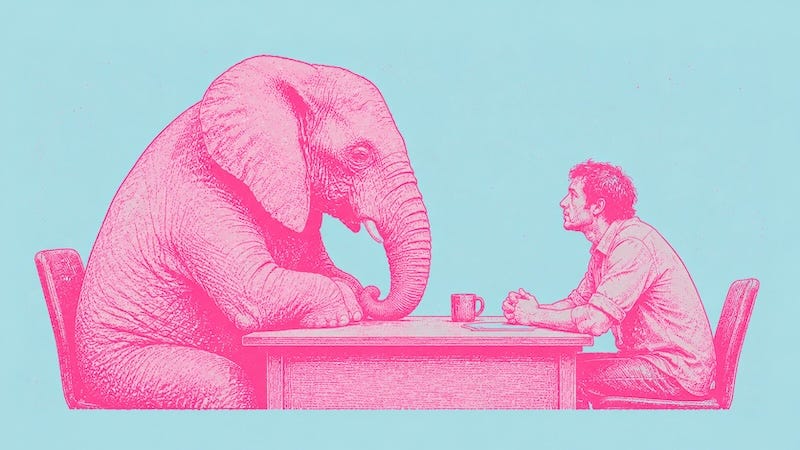
Let’s Get Back To That Elephant
Remember the pink elephant standing behind you? Of course you do. How can we forget.
The only way to stop thinking about the elephant isn’t to fight harder.
It’s to not fight at all.
And the way to stop fighting, is to change your relationship with the elephant.
Because that pink elephant standing behind you symbolizes all of your worst behaviors.
Every time you fight the elephant, you feed it. Your behaviors grow stronger.
It’s time to stop fighting the elephant and start asking why it followed you home in the first place.
Because it didn’t show up by accident.
And it won’t leave until you figure out why it’s there.
P.S. The pink elephant is still standing behind you, right? I thought so. You might want to do this 👇🏽
Understanding why your habits exist is exactly what the free Leadership Diagnostic Workshop will show you. Reserve your spot now. It’s free. But I already said that.
“Dieting Does Not Work,” Traci Mann, UCLA