

I talk to both Siri and Wispr Flow pretty much every day.
Siri hears the words I say. And that’s about all she does.
If I say something wrong, Siri transcribes it wrong. If I correct myself halfway through a sentence, Siri types the mistake, the correction and all the gobbledygook in between.
Every time I dictate something to Siri, I have to go back, reread it and fix half of what she wrote.
Sure, I could tell Siri to “try again.” But let’s not kid ourselves. We both know it’s only going to end with more work for me. At some point it’s just easier to do the damn thing myself.
Siri is basically the most annoying employee I’ve ever had.
Wispr Flow is different.
What Wispr Flow Actually Does
The first few times I used Wispr, it made mistakes too.
But I kept talking to it and a funny thing happened.
It started figuring me out.
It learned how I talk. It remembered the terms I use. It even learned how to correct my mistakes.
If I say, “Let’s meet Tuesday, actually wait, I mean Wednesday,” Wispr writes:
“Let’s meet Wednesday”
I don’t even have to tell it to delete Tuesday or explain what I meant.
It just knows.
And when it can’t quite figure what I’m saying, it usually understands my intention well enough to fill in the blanks.
I trust Wispr so much that I barely reread what it transcribes anymore.
Think about that. I’m trusting software to decide what I meant instead of what I said. And it does a great job.
Siri transcribes the words that come out of my mouth.
But Wispr understands who I am and what I mean.
That’s not just a technology difference.
That’s an employee difference.
And you’ve got both kinds working for you right now.
The Two Kinds Of People
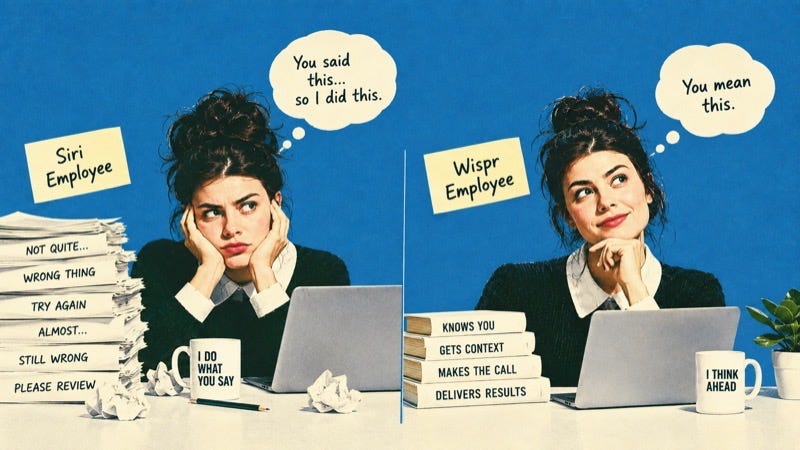
Most employees operate like Siri.
You give them instructions and they translate your literal words into a literal task. It’s literally annoying.
Sometimes it works perfectly. But a lot of times it doesn’t. They either do the wrong thing, or they do the right thing wrong.
Either way, you end up reviewing what they did, correcting it and explaining what you wanted.
Again.
And again.
That’s the relationship with Siri employees.
You talk.
They transcribe.
You fix what they did wrong.
Siri employees aren’t the ones who get promoted first. They’re the ones people stop trusting with complicated work.
The best employees are more like Wispr Flow.
They don’t just listen to what you say. They learn you.
They figure out how you think and what matters to you. They pay attention to how you make decisions and what you mean when you say something that probably made a heckuva lot of sense inside your head but not so much when it came out of your mouth.
And most of the time, they get it right.
The Real Reason They Get Promoted
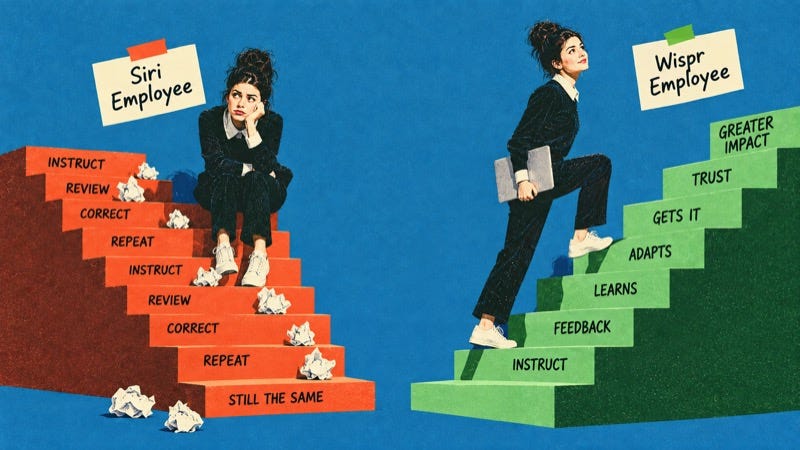
Every time you give an instruction to a Siri employee, you’re doing twice the work.
First you explain what you want. Then you check it, correct it or redo it.
And it never really gets better.
You could work with a Siri employee for three years and still have to explain things in gruesome detail because they never figured out how to understand the parts you didn’t say.
A Wispr employee is different.
Every correction you make is understood. Every mistake teaches them something. Every conversation you have gives them more context into who you are.
You don’t promote someone because they follow instructions well.
You promote them because they make your life easier.
That’s the difference.
The Flip Side
Of course there’s another side to this (isn’t there always?).
You’re somebody’s employee too.
Maybe it’s your boss. Your board. Or your biggest client.
I guarantee that there’s somebody giving you instructions.
And I guarantee those instructions aren’t always great.
Sometimes they’re incomplete. Some of them are confusing. Some are even said in a half-hearted hurry because they assume you’ll fill in the missing parts.
So what do you do?
Do you do exactly what they said and act surprised when what you did isn’t what they wanted? Or do you try to understand what they actually mean?
Because if you need everything spelled out perfectly before you can do great work, you’re not being careful.
You’re being Siri.
The difference between good and great isn’t how well you listen.
It’s how much you learn about the person you’re listening to.
P.S. I dictated most of this article using Wispr. It fixed my mistakes and somehow figured out what I meant. I didn't reread a single sentence until I pasted it here. That's kinda the point.
Were you thinking of any people in particular as you read this article? Do tell.