

My client was crushing it.
Their revenue doubled in two years. They were expanding their offices, hiring faster than they could find people, and celebrating their success whenever they had a moment to breathe.
Which wasn’t often.
Shortly after they passed $100 million in revenue, they even got a call from a national brand with strong interest in acquiring them.
The CEO went to bed every night with a smile on his face. He had a great company with a great team.
Or so he thought.
The CEO Saw Success
The CEO was an energetic chap, to put it mildly. His personality was like a Labrador puppy - bouncy, friendly and just wanting to be liked, but all with an ADHD aesthetic.
As the acquisition deal moved forward, his energy level went from high to “this guy really needs a Valium.”
At one point he called an all-hands meeting to address the acquisition rumors head-on.
He told the team how amazing everything was.
He hyped the fact that they were entering an exciting new phase.
He went on for about 10 or 15 minutes, then asked if anyone had questions.
Nobody did.
He reminded them about his open door policy and ended the meeting elated.
He knew the company was headed in the right direction. He knew they were doing great and was convinced the employees were happy.

The Employees Saw Disaster
In reality, the company culture was terrible. Employees were furious and the all-hands actually meeting made it worse.
The staff thought the CEO was an uncaring, unauthentic buffoon who was ignoring the company’s real problems.
And the company’s problems were definitely real.
They were suffering from the types of operational and systems issues that come with rapid growth. They could be resolved over time, but they would detonate if there were dramatic change before then. Like, say, an acquisition.
Meanwhile, budgets were tight, innovation was disappearing and the company vision had all but vanished.
The CEO saw it from a completely different perspective. From his point of view, everything was great.
Budgets were temporarily tightened to increase the company’s value for the acquisition.
Innovation was slightly slowed to prove they could generate more revenue from existing products.
The vision was sidelined because the CEO was spending all his time on the acquisition.
Everything the CEO did was geared toward growth. But a different growth than what the day-to-day workers were doing.
He assumed everybody knew and understood his perspective.
They assumed the CEO understood their perspective.
As it turns out, they both were correct in their beliefs - even though they had completely opposing views.
And neither side had any idea the other saw things differently.
There are three sides to every story - your side, my side, and the truth. And none of them are wrong.

The Research Says The Iceberg of Ignorance Is Normal
In 1989, a researcher named Sidney Yoshida documented something that disrupts all of our assumptions about communication.
Top managers are aware of 4% of company problems.
Front-line employees are aware of 100% of them.
He called it the Iceberg of Ignorance.
We often assume our superiors are aware of our problems. They aren’t.
That was 1989, though. Things must have changed in 35 years, right?
Wrong.
In 2015, ThinkWay Strategies did a survey that confirmed the gap still exists.
61% of executives said their organizations had “efficient and effective processes with minimal waste.” But only 27% of employees agreed.
In other words, two-thirds of leadership think a company is productive but three-quarters of front-line employees disagree.
That’s a pretty hefty gap.
But it gets worse.
Here’s How It Gets Worse
I conduct a lot of hugely insightful Culture & Leadership Surveys for companies.
I ask leaders to rate themselves on things like communication and transparency. Then I ask their teams to rate them on the same things.
Leaders consistently rate their positive behaviors 30 to 40 percent higher than their teams rate them.
Every. Single. Time.
Not only do leaders not know about most of the problems - they don’t even know they don’t know.
You think you’re communicating well. You’re not.
You think your open door policy works. But nobody walks in.
You think people feel safe speaking up. But nobody’s talking.
The iceberg isn’t just big. The damn thing is practically invisible.
Why The Communication Gap Exists
There are two reasons for the communication gap. One is expected. One is a problem.
The Structural Gap
Leaders focus on strategy. Managers focus on operations. This is expected.
The higher you rise in an organization, the further you get from operational problems.
That’s not a bug, that’s the job. In fact, I made a diagram to explain it.
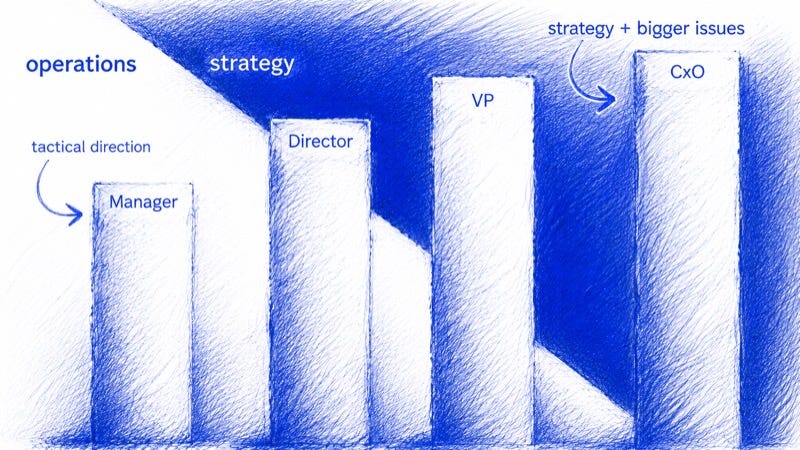
A CEO can’t fix the broken process du jour and still guide strategic direction. There’s not enough sanity in the day to do all that.
Similarly, a manager can’t focus on long-term strategy while herding cats and putting out fires all day.
Different roles require a different focus with different information. That’s just the way it is.
It’s inevitable that company leaders won’t know all the problems that employees do. That’s accepted and won’t change.
That’s the Structural Gap.
But then there’s the Perceptual Gap.
The Perceptual Gap
The perceptual gap is the part where you think you are doing things better than you actually are.
There are two things that heavily influence this. The first is the MUM Effect - which is one of the best named effects this side of the Zeigarnik Effect.
The MUM Effect
In 1970, psychologists Sidney Rosen and Abraham Tesser found that people are reluctant to tell others bad news because delivering bad news makes the messenger feel bad. Surprisingly, it has little to do with the recipient.
Your team has problems and they’re hesitant to tell you - not because of how you’d react, but how they will.
They are protecting themselves from the discomfort of being the bearer of bad news.
And that brings us to the leadership illusion.
The Leadership Illusion
You think your open door policy works.
You think your all-hands Q&A creates transparency.
You think asking “anyone have questions?” at the end of a meeting means people feel safe speaking up.
If you bothered to do a Leadership & Culture Survey, you’d be surprised at how wrong you are. Because the way leaders perceive their behavior is usually much different from how it’s perceived by others.
That’s the leadership illusion.
When you say you have an open door policy, you are convincing yourself that people feel comfortable confiding in you.
But from your team’s perspective, you’re always in closed doors meetings, and when they do talk to you about an issue, you explain to them how they’re wrong.
Your self-perception is wrong and everybody knows it… except you.
[Editor’s Note: he’s got a free workshop to address your self-perception]

The Iceberg Of Ignorance Isn't Going Away.
You can’t get rid of the iceberg of ignorance.
The structural gap will always exist because leaders and employees are inherently focused on different things that bring different awareness.
But you can stop making it worse.
The problem isn’t that you don’t know about all the problems.
The problem is thinking you know more than you do.
Your team isn’t telling you the truth. You just think they are.
And the gap between what you think is happening and what’s actually happening is wider than the iceberg itself.
So why don’t we agree on this:
You don’t know everything happening in your company.
Your team isn’t going to tell you.
The gap between what you think is happening and what actually is — that’s not a communication problem.
That’s an iceberg.
And you’re the one ignoring it.
P.S. — The acquisition went through. Six months later, 15 people resigned including three of his best people. The CEO was genuinely surprised. Everybody else was not.
It’s time you understood the patterns hiding in your blindspot.
Learn more about the free Leadership Diagnostic Workshop.