
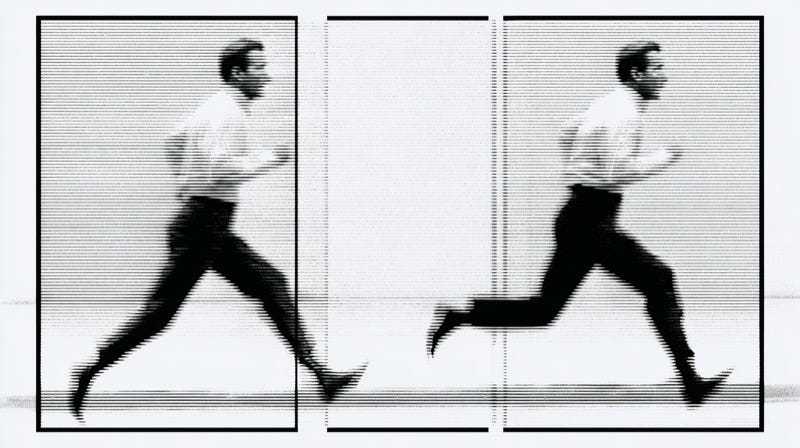
Imagine someone takes a photograph of you while you’re running.
It’s not one of your best photos.
You have one foot in the air, your arms are swinging somewhat wildly and your face is twisted in a “do I really look like that?” type of way.
Then they hand you the photo and say, “This is exactly how you walk, run and move through the world.”
You think they’re insane.
But that’s what they told you, so you accept it as the truth.
Sounds ridiculous, right?
I know.
So riddle me this, Batman, why is that exactly how you treat personality tests?
The Big Five Personality Traits
In the 1900s, psychologists agreed on five behavioral tendencies to describe our personalities. These are known as the Big Five personality traits. They are:
Openness - how much you look for new experiences vs. sticking with what you know works
Conscientiousness - how much you prioritize order and discipline vs. flexibility
Extraversion - how much you get energy from being around other people vs. being alone
Agreeableness - how much you prioritize harmony between people vs. your own position
Neuroticism - how much you scan for threats vs. assume stability
Each trait is measured on a spectrum.
You’re not an introvert or an extrovert - you’re some blend.
You’re not open to new experiences or closed to them - you fall somewhere on the continuum.
That’s what personality tests measure.
At some point you’ve probably taken a Myers-Briggs, DiSC, CliftonStrengths or some other popular personality tests. 50-80% of workers have1.
All of the well known tests are psychologically credible measurement tools of the Big Five.
And that’s where the problem begins.
Because when something is scientifically credible, you treat it like the truth.
The Permission Slip You Didn't Know You Signed
If you’re like most people, you’ll view the results of your personality test as a diagnosis of who you are.
But you’re wrong.
It’s like taking a snapshot of your current behavioral patterns, and then believing that picture represents the same exact person you were five years ago and the same one you’ll be five years from now.
Here’s what you do:
You take the test.
You get your results.
You read them.
They seem to resonate. It kinda sorta feels like it describes you.
So you use the results to explain your behavior, instead of changing your behavior.
Don’t think you’re doing it?
Well, my friend, think for a moment if you’ve ever said anything about yourself similar to these comments I hear often from my leadership coaching clients:
“I can’t help it, I’m an introvert.”
“It doesn’t make sense because I’m highly conscientious.”
“Conflict isn’t my thing, I’m better at maintaining peace.”
“I’m just a detail-oriented person.”
“I’m a high achiever - that’s the way I am.”
If you have - and most people have - you’re an unknowing victim to the personality test diagnosis trap.
A Snapshot. Not A Sentence.
The psychologists who created the personality tests never claimed your trait balance was fixed forever. Heck, they never even said it would be the same next year as it is today.
Research consistently shows that personality traits change over time. In fact, they can change significantly in as little as 15 weeks.
That means your personality test doesn’t reveal your true identity - it only reveals your current habits.
That distinction is super important for you to understand.
Habits can change.
In fact, habits have to change as you mature and your career develops.
The test isn’t wrong, your interpretation of it is.
You have to look at personality tests in a completely different way.
Your test results aren’t statements, they’re questions. They’re not telling you who you are as much as asking you if your patterns are still benefitting you.
What Your Personality Test Score Is Actually Asking You
If you scored low on Openness, it means you don’t actively look for new experiences. You focus on sticking with what works. That made you reliable when you were an exceptional worker, but the same behavior can now hold you back from getting your next promotion.
If you scored high in Conscientiousness, it means you’ve been fairly disciplined. That pattern probably made you successful as an individual contributor, but the same pattern will work against you when you’re leading a team.
So the big question to ask yourself is, “Does this personality trait still help me or do I need to change it?”
Because you can change it if you want.
How do I know?
I’ve done the same with myself.
Plus, I guide the same kind of change for hundreds of leaders around the world, from Global 100 execs to early stage entrepreneurs.
When you stop looking at your personality test as a crystal ball and start understanding it’s just a photograph in time, you can start using the information in your favor to help guide the changes you need, and be the person you want.
But if you treat them as the truth about who you are, you’ll forget that you’re the one choosing the pattern.
Stop Staring At The Photograph
Remember that photograph running that we talked about at the top of this article?
It’s time to stop staring at the photograph.
Start moving forward.
Your personality test didn’t ever limit you.
You’re the one that gave it that power.
It’s time to take that power back.
—
Do you wonder which of your personality traits are still helping you, and which ones are now the problem?
That is exactly what I help you diagnose in the free Leadership Diagnostic Workshop.
P.S. — The behavioral trait you were thinking about while reading this? That's the one you really should understand better.
INNER CIRCLE MEMBERS (aka paid subscribers) get free stuff!
Become a member now, and see what I wrote down there 👇🏽👇🏽👇🏽