
I’m ecstatic that this article is sponsored by Granola.ai - the best AI meeting notes solution (and now unicorn status). It’s soooo good. Trust me, I’ve been using Granola for 6 months and can’t live without it. So I became an affiliate - and that gives you a free month. I gotchoo.
Get a free month of Granola.ai
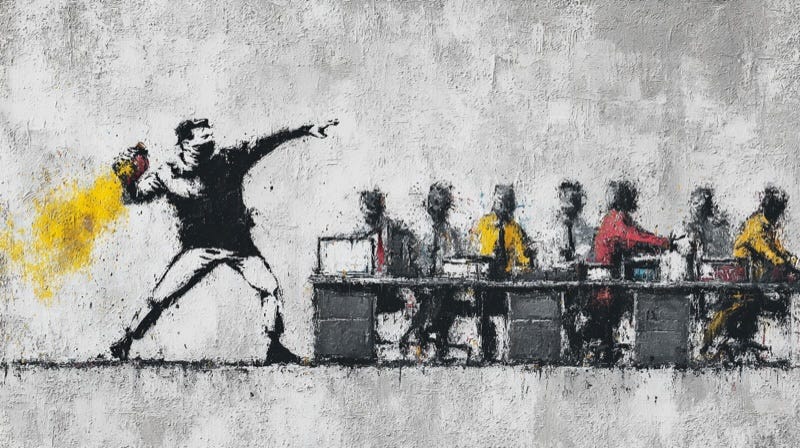
I cringed every time I heard my account managers talk with clients about our upcoming features.
They’d say, “The tech team is working on it,” and a pit would form in my stomach.
“I don’t know when they’ll be done,” the account manager would continue - and I died a little more inside.
I remember one call specifically. It was the final straw.
Lisa, a smart and highly competent account manager, was on a Zoom with one of our top clients. The client asked when a new feature would launch.
Simple question.
Uncomfortable answer.
You see, we’d been promising this feature for months. But client needs changed. Then the product team added complexity. Suddenly we were 2 months late.
But if anybody on the account team could keep a client happy, it was Lisa.
“I don’t know when it will be released,” she told the client. “They keep changing the timeline.”
“Who’s ‘they’?” the client asked.
Lisa paused, “You know... the tech team.”
“Ah,” the client said.
And that’s when the problem erupted in my head.
This wasn’t a tech problem.
Not a timeline problem.
Not even an accountability problem.
We had an identity problem.
And it all revolved around one word:
They.
The most dangerous word in leadership is “they.”
If one word can destroy careers, cultures and companies, that’s the word.
They.
Weird, right?
I know.
I mean, it’s not an imposing word like “quit” or “failure”. It’s demure. It’s standing quietly over there, hiding in the shadows of conversation.
That’s why it’s so deadly.

What “They” Really Means
In the world of company culture, “they” isn’t a pronoun. It’s a permission slip.
It’s permission to abdicate responsibility.
To deny accountability.
To say the company culture is crap “but it’s not my fault.”
By saying “they”, you’re refusing to be a part of the “we.”
When you say “they’re delayed” or “they don’t get it” or “they’re working on it,” you’re drawing a line where you’re on one side and “they” are on the other.
It’s Us vs Them.
Think of it like you’re at a family dinner talking crap about your family in the third person while they’re all sitting right there in front of you.
It’s absurd. Yet I see it all the time with my leadership coaching clients.
Here’s What Actually Breaks
You may not see how the use of "they" is breaking things at your company. It's subtle - like letting your kid draw on one wall. Seems harmless. Until they're drawing on every wall. And the couch. And the cat.
Let me explain how it happens.
First, communication devolves.
When you refer to the other team as “they,” you’re blaming them for the company’s failures. They’ll feel unfairly accused and start talking about all the things that your team screws up.
“They” is the spark that ignites the fire of blame.
And then collaboration declines
Anger and resentment builds as the teams blame each other for all the minutiae.
Each team gets increasingly frustrated with the other and purposely avoid working together.
Instead of collaboration, you get alienation.
Then productivity gets demolished
Without collaboration, tasks don’t get done well - or at all.
Projects that are started don’t get finished.
People miss deadlines.
They create ineffective solutions to real problems.
And if you don’t do something about it, the kids will be drawing on the cats.
Eventually your company culture will become toxic
Your best employees quit. Your clients become unhappy and your revenue growth slows down (or worse).
All because you allowed the use of the word “they”.
If only “they” did their job well.
If only “they” had better people on staff.
They they they.

The Customers Don’t Care
Too many leaders think it’s an accountability problem.
They think it’s a productivity problem - or a communication problem.
It’s none of those.
You’ll always have a company of “they” if you never define the “we”.
When Lisa said, “the tech team is working on it,” she wasn’t just abdicating responsibility, she was telling our client that she didn’t see herself as part of the same team.
Here’s the thing:
Customers don’t give a shit about “they”.
Customers assume companies are unified. They assume you are a bonded and effective “we”.
When you tell them that the company is split, it doesn’t make the customer feel better. It makes them feel worse.
Customers will loose loose faith in companies because of “they”.

The Fix Isn’t What You’re Thinking It Is
Most people think that if they just stop saying “they,” then everything will magically be fixed.
They’re wrong.
The fix is not to say “we” - it’s to define “we.”
Who are we?
What do we own?
What do we stand for?
How do we behave when things go wrong?
How do we work better together than apart?
Once you know your “we”, then it’s time to shift your language.
But the shift you need is NOT from “they” → “we.”
[plot twist]
It’s from “they” → “we” → “I.”
—
Think about it…
“They missed the deadline”
becomes “We missed the deadline”
becomes “I changed our requirements without clearly communicating it.”
“They’re not aligned”
becomes “We’re not aligned”
becomes “I haven’t effectively defined what alignment means for us.”
“They don’t get it”
becomes “We don’t get it”
becomes “I haven’t made it clear enough.”
Get it?
”They” lets you off the hook.
“We” spreads the responsibility.
“I” puts you right in it.
And that’s where personal growth - and leadership growth - happens.
Right there in the middle of the “they”.
Epilogue
I fixed the problem with my account team’s terminology - not by telling them to stop saying “they,” but by better defining our “we”.
We were one company with one goal: solving our clients’ biggest problems.
It didn’t matter if you were on the tech team, product team, sales team or account team - we were all responsible for the client experience.
If something wasn’t working, we owned it together.
“We” owned it.
When Lisa had to give a client an update, she stopped blaming anyone else. “We” were all in it together.
One team. One identity. One purpose.
When that happens, something big shifts - and everybody can feel it.
Each team starts showing up in better ways with better questions.
More innovative solutions get uncovered and problems get solved faster because people stop blaming and start owning.
So here’s my question for you:
Where are you saying “they” instead of leaning into the “we” and the “I” - and what the heck are you going to do about it?
Maybe it’s time we all made the change.
—
Join me on Substack Live this Thursday, Feb 12, as I’ll talk more about The Most Dangerous Word.
If you have stories you can share, bring them along or email me!
If this resonates with you, I run a diagnostic workshop that helps you uncover the patterns holding you back.
Join the waitlist for a chance to get a seat at the next one.
The "they" → "we" → "I" progression here is brilliant. I see so many leaders in my work (myself included at times) who think switching to "we" is the finish line, but that's where the real work actually starts. The uncomfortable part, and the part most skip, is landing on "I didn't set clear expectations" or "I assumed alignment without building it." That's where the growth happens, and it's exactly why people avoid it.
The Lisa example nails what I hear in client debriefs all the time: leaders don't realize how "they" language signals to everyone (including customers) that the organization is fractured. You can't coach trust and ownership into a team if the language reinforces silos. ← Working through this right now with a client actually.
Great write up!
"They." "They?" "Who is They?" "Well, you know...Them." Arggh.